A drone OEM founder told us at XPONENTIAL, unprompted, about ten seconds after we shook hands:
We have some cells that are not meeting what we believe to be our standard, but we haven't documented our standard well enough to hold up to a standard. We've been copy-pasting what our supplier's standard is.
It is worth sitting with that sentence. He named the gap, the supplier, and the deliverable in one breath, and he was clear-eyed about it. He is not a sloppy founder. His company is shipping. He just hasn't gotten around to writing a real cell acceptance spec yet, because no one — not his supplier, not his customers, not his investors — has forced him to. So the spec he's holding suppliers to is, in effect, the supplier's own marketing document.
If your supplier wrote your spec, you don't have a spec. You have a sales sheet with your logo on it.
This series is for the engineers and founders in that position. You buy packs, or you buy cells and minimally process them into packs. You know you need a real cell testing program. You don't have the equipment, the documented protocol, or the experience to stand it up. And the first thing you hit when you start looking is a closed analytics platform asking for a six-figure multi-year commitment to be the answer — before you've even written your first acceptance criterion.
That sequence is backwards. Over three parts, here is the sequence we'd suggest instead. This first part is about the problem: what a one-time qualification does and doesn't catch.
What your one-time qualification didn't catch
Most teams in this position have already done something — they ran a cell through some characterization at design time, decided it met their needs, and locked it into the bill of materials. That's qualification. It proves the cell type, on the bench, on the sample you tested, is capable of what you need. It's necessary. It's not sufficient.
Two things vary that your qualification didn't catch — and that your supplier has no obligation to tell you about.
Batch-to-batch variation. Cell suppliers don't ship one cell. They ship batches, and the batches drift. A new raw-material lot, a retooled electrode coater, a tweak to calendaring tolerance, a new operator on the formation line — none of this generates a customer notice. As long as the batch falls within the spec range on the data sheet, the supplier is free to vary capacity, impedance, and self-discharge by some percent batch over batch. Same cell, different reality. The batch you qualified on is not the batch in your last shipment, and without sampling you have no way to know how far apart they are. Grade binning. This is the one most pack buyers genuinely don't know about, so it's worth slowing down on. Cells coming off the line don't have identical performance — there's a distribution. The manufacturer measures every cell, then bins them: A-grade (top capacity, tightest impedance, longest projected cycle life), B-grade, C-grade, reject. The premium customers — the ones who specify acceptance criteria, sample incoming, and push back on out-of-spec lots — get the A bin. The customers who don't test get whatever bin clears the inventory.The datasheet shows the spec range, often anchored close to A. The cells in your last shipment, statistically, were probably not A. The supplier knows what bin distribution they sent you. You don't, unless you measure.
Put the two together and the case for ongoing sampling stops being abstract. Batch variation tells you that the cells will drift. Grade binning tells you which direction the drift is most likely to go for a customer who isn't watching. Sampling is how you find out you got downgraded before your customer does.
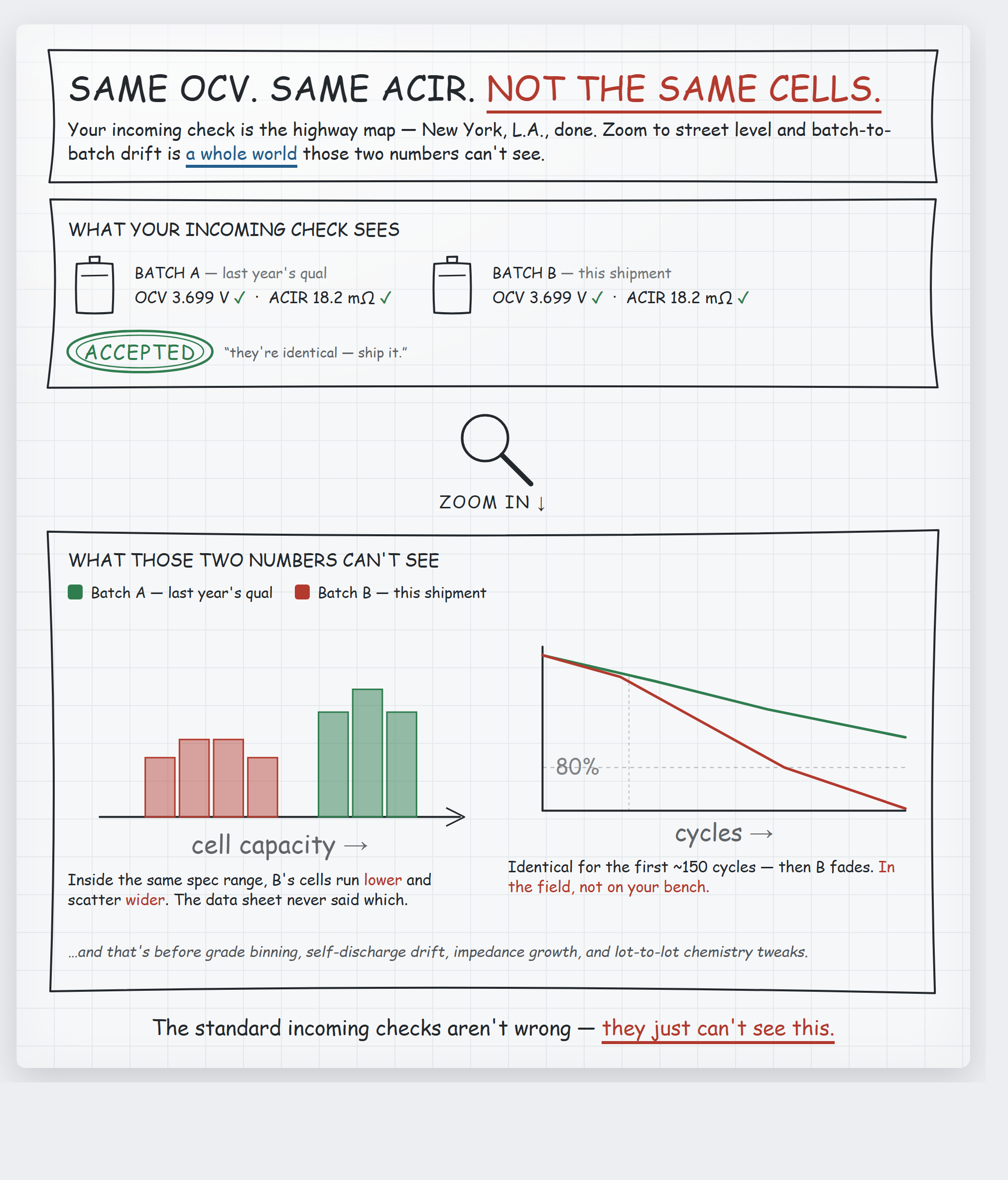 Same OCV, same ACIR, accepted — and still not the same cells. The two numbers an incoming check reads can't see batch-to-batch capacity and cycle-life drift.
How most teams find this out
Almost nobody arrives at this prospectively. The pattern is depressingly consistent: you ship product, things work, and you don't think about batch variation because nothing has forced you to. Then a customer calls. A pack underperformed, or a unit failed in the field, or a fleet of returns came back with the same anomalous behavior, and now you need to know what happened.
The goose chase that follows is its own special kind of expensive. You pull whatever records you have — purchase orders, lot codes on the cells if you bothered to track them, the qualification data from two years ago. You try to figure out which batch the failed cells came from. You realize the lot codes aren't in your ERP, or they are but they're not linked to the serial numbers of the packs you shipped, or they are but you have no contemporaneous test data from those batches to compare against the cells that didn't fail. You ask your supplier for production records and get back exactly what their lawyer wrote — enough to be responsive, not enough to be diagnostic.
A week later your engineering team is reverse-engineering a cell qualification program from a field failure, under deadline, with the customer on the phone weekly. Whatever cell program you build at that point will be more expensive, less rigorous, and a lot less defensible than the one you would have built quietly two years earlier.
The version of this story where it goes well is the version where you had the data the whole time. Lot codes tied to packs, samples from each batch in a freezer or on a cycler, a test history you can query in an afternoon. The point of standing up the program before you need it is not that nothing will ever go wrong — it's that when something does, the next two months of your life look different.
So that's the problem. The natural next question is how much testing is actually enough — and the honest answer is that it depends on who you want to sell to. Part 2 lays out the cell-testing ladder.